
10 Tips for Choosing the Right Ceramic Rod?

Choosing the right Ceramic Rod can determine whether a component performs reliably or fails under pressure. The choice affects strength, heat resistance, insulation, wear, and service life. A rod that looks smooth may still contain hidden flaws.

W. David Kingery, a respected ceramic materials scientist, famously said, “The history of ceramics is the history of mankind.” His observation reflects the long development of ceramic materials and their practical value. Modern buyers must apply that knowledge carefully.

A good selection begins with the working environment. Will the Ceramic Rod face sudden temperature changes, abrasive contact, electrical voltage, or corrosive chemicals? Alumina often suits electrical insulation and high-wear applications. Zirconia may offer greater toughness. Silicon nitride can perform well under demanding thermal conditions.

Dimensions matter more than many buyers expect. A small diameter error can create alignment problems in a precision assembly. Surface finish also deserves attention. Run your finger across the rod. Tiny scratches can become stress points.

Supplier documentation should include material grade, tolerance, density, hardness, and inspection results. Ask for traceability. Do not rely only on a product photograph.

Testing remains essential.

Samples should be checked under realistic loads and temperatures. In my experience, buyers sometimes select the hardest material and overlook thermal shock. That decision can be costly. No guide is flawless, either. Application data may be incomplete, and laboratory results may not match field conditions.

These ten tips provide a practical starting point. They help engineers compare materials, clarify specifications, and choose a Ceramic Rod with greater confidence.
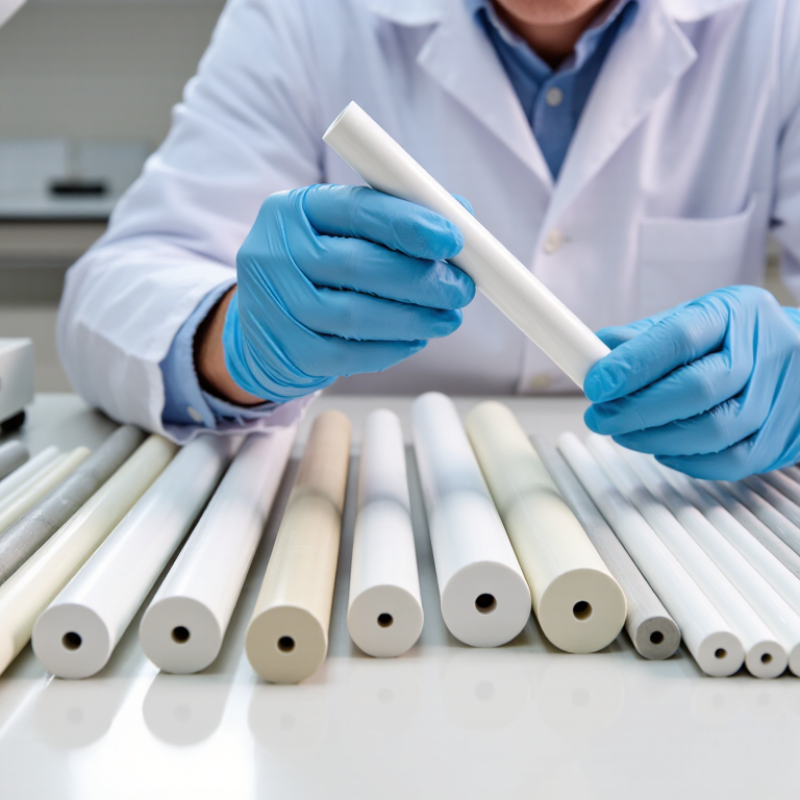
10 Tips for Choosing the Right Ceramic Rod?

Define the Rod’s Duty: Insulation, Wear, Heat, or Chemical Service

Choosing a ceramic rod starts with its duty, not its diameter. Will it insulate electricity, resist abrasion, survive heat, or tolerate chemicals? Each requirement changes the material and geometry. Alumina is often selected for electrical insulation because ASM Handbook data places its thermal conductivity near 20–30 W/m·K and dielectric strength commonly above 10 kV/mm. However, purity, porosity, and surface finish can shift actual performance.

Tip: Write the duty in one sentence.

For abrasive contact, compare hardness, fracture toughness, and edge strength. ASTM C1161 testing helps evaluate ceramic flexural strength, but laboratory values do not perfectly represent vibrating assemblies. For continuous heat, check the full temperature cycle, not only the maximum rating. Thermal shock can crack a rod during rapid cooling. IEC 60672 guidance also reminds engineers to classify insulating ceramics by electrical and mechanical service, rather than relying on one property.

Chemical service needs equal caution. A rod exposed to acids, alkalis, molten salts, or cleaning fluids may require a specific ceramic composition and glaze. Review compatibility data at the actual concentration and temperature. I once treated “chemically resistant” as a complete answer. It was not. Small pores became the weak point.

Tip: Match the test environment to the process.

Ask for batch-level dimensional tolerance, density, porosity, and inspection records. ASTM C373 methods can support water absorption and apparent porosity checks. Small differences matter. A tight-fit rod may fail from installation stress, even when its material data looks excellent. Verify load, span, heating rate, and mounting details before approving the design.

Match the Ceramic: Compare 95–99.9% Alumina, ZrO₂, AlN, and Si₃N₄

Ceramic rod selection starts with chemistry, not catalog appearance. The key question is where heat, wear, or fracture will dominate. ASM Handbook, Volume 4A, reports dense alumina thermal conductivity near 20–30 W/m·K, depending on purity. At 95–99.9% Al2O3, higher purity usually improves insulation and corrosion resistance. It can also increase cost and brittleness. That trade-off matters.

ZrO2 is different. Its thermal conductivity commonly sits near 2–3 W/m·K. Transformation toughening can provide roughly 5–10 MPa·m½ fracture toughness, according to ASM International property data. This makes zirconia attractive for shock-prone rods and precision wear parts. However, stabilized grades respond differently to heat and humidity. Do not compare one datasheet blindly. I have seen nominally similar rods fail differently after machining.

For heat spreading, AlN often reaches 140–200 W/m·K. The U.S. Department of Energy’s wide-bandgap semiconductor reports identify thermal management as a major application driver. AlN suits electrically insulating heat-transfer fixtures, but moisture and surface finish deserve attention. Si3N4 generally offers lower conductivity, around 20–90 W/m·K, while providing strong thermal-shock resistance and fracture toughness. These ranges come from ASM Handbook data and technical ceramic property reports. Published values shift with density, porosity, additives, and test method. Ask for the actual test standard, not only the headline number.

Verify Strength: Review 300–1,000 MPa Flexural Data Under ASTM C1161

10 Tips for Choosing the Right Ceramic Rod?

Verify Strength: Review 300–1,000 MPa Flexural Data Under ASTM C1161

Ceramic rods advertised between 300 and 1,000 MPa require careful verification. Flexural strength is not a universal material constant. It changes with composition, diameter, surface finish, and internal flaws. ASTM C1161 provides a recognized method for testing advanced ceramics at room temperature. Ask for the complete report, not only a marketing value.

Check whether the test used three-point or four-point bending. These setups create different stress distributions and may produce different results. Confirm specimen dimensions, loading rate, sample quantity, and failure location. A reported 600 MPa value means little without this context. ASM Handbook, Volume 4A, identifies flaw sensitivity and surface condition as major influences on ceramic strength. Small scratches can become serious failure origins.

Look for data from multiple specimens and request Weibull analysis when available. A single impressive result is weak evidence. Industry engineering datasets commonly show wide strength variation among technically similar ceramics. This matters when rods face vibration, thermal cycling, or repeated loading. I would also compare the certified value with the expected working stress, leaving a practical safety margin. That judgment is not always simple. A rod can pass a laboratory test and still fail after poor machining or careless installation. Personally, I would reject any supplier report that omits test configuration, batch traceability, or calibration details. Reliability begins with complete evidence.

Check Thermal and Electrical Ratings Against IEC 60672 Requirements

10 Tips for Choosing the Right Ceramic Rod

Thermal and electrical ratings should lead your ceramic rod selection. IEC 60672-1 classifies ceramic insulating materials by composition and performance. IEC 60672-2 defines test methods for dielectric strength, resistivity, and thermal behavior. IEC 60672-3 provides specification frameworks for different material groups. Do not treat one rating as universal.

Check the continuous operating temperature, short-term peak temperature, thermal shock resistance, and thermal expansion coefficient. Then compare dielectric strength in kV/mm, volume resistivity in Ω·m, and insulation resistance after conditioning. Confirm the test temperature and specimen thickness. Small differences can distort comparisons.

Moisture matters. CIGRE technical guidance repeatedly identifies contamination and humidity as major influences on surface insulation performance. Keep the rod clean during evaluation.

Measure the actual load path. Verify rod diameter, length, machining tolerance, and mounting pressure. Inspect for chips around drilled holes. Ask for batch-level test records, not only a catalogue value. Review aging data after repeated heating cycles. Check whether the stated rating covers continuous service or brief exposure.

Confirm electrical clearance under real voltage. Use guard rings when testing high resistance. Do not ignore thermal gradients. A rod may survive a furnace test yet crack near a metal fitting.

I have seen selection decisions rely too heavily on room-temperature results. That shortcut deserves review. Validate samples under the intended humidity, voltage, temperature, and mechanical stress before approval.

Confirm Dimensions, Surface Finish, Traceability, and ISO 2768 Tolerances

Choosing the right ceramic rod starts with dimensions, not appearance. Confirm diameter, length, straightness, and end geometry against the working drawing. A rod that looks precise can still create alignment problems. Measure samples with calibrated equipment, and record the measurement temperature. Ceramic expands less than metal, but temperature differences still affect close fits.

Surface finish deserves equal attention. Ask for the specified roughness value, such as Ra, rather than accepting “polished.” Inspect the ends for chips, cracks, and uneven grinding marks. A smooth shaft may still have damaged edges.

I once approved a visually clean rod without checking its ends. That shortcut was wrong. The rod later caused unstable contact in a test fixture.

Traceability supports reliable decisions. Request the material grade, production lot, inspection report, and applicable processing records. These details help connect a failed part to its manufacturing history.

Check whether ISO 2768 tolerances apply to the rod itself or only to a related drawing. General tolerances are useful for non-critical dimensions, but they cannot replace tighter requirements for bearing fits or precision alignment.

Ask for individual tolerances when performance depends on them. Keep the documents with the received parts. That small habit prevents confusion months later. Avoid assuming every certificate proves every characteristic; verify the measured values and inspection method.

SERVO-ROBOT Inc
Privacy Overview

This website uses cookies so that we can provide you with the best user experience possible. Cookie information is stored in your browser and performs functions such as recognising you when you return to our website and helping our team to understand which sections of the website you find most interesting and useful.