
Why Choose SUS304L Stainless Plates for Global Buyers?

Why Choose Sus304l Stainless Plates for Global Buyers?

Global buyers need more than a bright surface and a competitive quotation. They need predictable chemistry, stable fabrication, and documents that survive technical review. SUS304L Stainless Plates remain popular because their low carbon content supports cleaner welded joints and reduces the risk of intergranular corrosion after welding. The grade also offers practical resistance to moisture, food-processing environments, architectural exposure, and many moderate chemical services.

World Stainless reported approximately 58.4 million tonnes of stainless crude steel production in 2023. That scale reflects continuing demand, but it also reveals a crowded supply chain. Not every plate offers identical performance. Buyers should verify ASTM A240 or EN 10088-2 compliance, heat numbers, test certificates, thickness tolerance, surface finish, and ultrasonic testing requirements.

Small details matter.

John E. Bringas, editor of Handbook of Stainless Steels, states, “Stainless steels are iron-base alloys containing a minimum of 10.5% chromium.” This definition sounds basic, yet it explains the importance of controlled composition. Chromium supports passivation, while nickel helps maintain the austenitic structure expected from 304L.

The Nickel Institute’s technical guidance also emphasizes that corrosion resistance depends on the environment, fabrication quality, and maintenance. That point deserves attention. SUS304L is not universally corrosion-proof. Chloride-rich seawater, stagnant crevices, and aggressive acids may require 316L or a more specialized alloy.

For international projects, dependable sourcing matters as much as grade selection. Compare mill origin, inspection practices, packaging, and traceability. A lower price may conceal greater finishing or replacement costs. That is easy to underestimate.
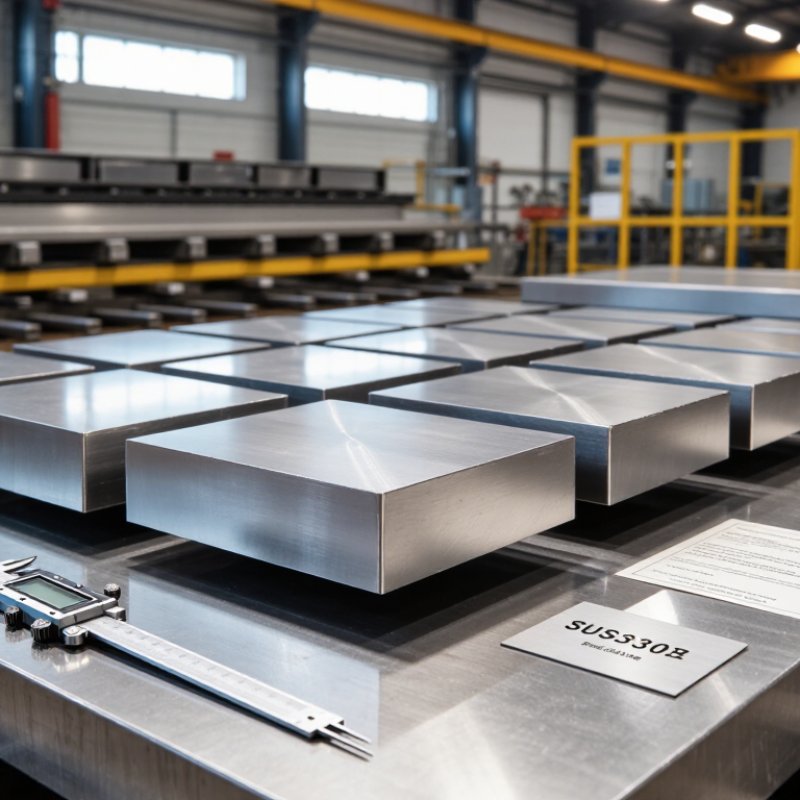
Why Choose SUS304L Stainless Plates for Global Buyers?

SUS304L Stainless Plates: Composition and Key Material Properties

SUS304L stainless plates are commonly aligned with UNS S30403 and EN 1.4307.

Their low carbon content is the defining feature. ASTM A240/A240M limits carbon to 0.030%. Chromium typically ranges from 18% to 20%, while nickel ranges from 8% to 12%. Manganese is limited to 2.00%, and silicon to 0.75%. These elements support a stable austenitic structure and reliable forming performance.

ASTM A240/A240M lists minimum tensile strength near 485 MPa, yield strength near 170 MPa, and elongation of 40% for annealed plate.

Density is about 7.9 g/cm³.

The low carbon level reduces chromium-carbide precipitation during welding. It does not make the plate immune to corrosion. Chlorides, surface contamination, and poor drainage can still cause pitting. That detail is often underestimated.

Tips:

Ask for heat numbers, chemical test results, and mechanical test reports. Check whether the certificate references ASTM A240/A240M or EN 10088-2. Plate thickness also affects flatness and forming behavior. A familiar grade is not always a perfect match. Compare the actual service temperature, weld design, and chloride exposure before purchasing.

Why SUS304L Offers Reliable Corrosion Resistance

Why Choose SUS304L Stainless Plates for Global Buyers?

SUS304L offers reliable corrosion resistance because its chromium-rich surface forms a thin, self-repairing passive film. In ordinary indoor, food-processing, and mildly coastal environments, this film helps protect plates from moisture and oxygen. The low-carbon grade also reduces carbide precipitation during welding, which supports better resistance around welded seams. Clean fabrication matters.

The NACE IMPACT study estimated global corrosion costs at US$2.5 trillion, or 3.4% of global GDP. It also indicated that 15–35% of corrosion costs could be reduced through improved management. For buyers, this supports a practical choice: specify suitable stainless steel, then control installation and maintenance carefully. SUS304L is not corrosion-proof. Chloride deposits can cause pitting, especially under wet packaging, bolts, or stagnant water. Coastal salt is unforgiving.

In plate inspections, I would check surface condition, weld discoloration, drainage, and storage exposure—not only the material certificate. ASTM G48 testing can help compare pitting resistance, but laboratory results do not perfectly reproduce every service site. That limitation deserves attention. Regular rinsing with clean water, removal of iron contamination, and dry storage can preserve the passive surface. For severe marine, chemical, or high-temperature service, a higher-alloy grade may be more appropriate.

Fabrication, Welding, and Forming Advantages of SUS304L Plates

Why Choose SUS304L Stainless Plates for Global Buyers?

SUS304L plates are valued for practical fabrication work. Their low carbon content helps reduce carbide precipitation after welding. This matters when fabricators cannot solution anneal large assemblies. Welded tanks, brackets, frames, and hygienic panels often benefit from this property. Clean edges also support more consistent cutting and fit-up. However, good results still depend on heat control and joint preparation.

The plate forms well under controlled pressure. It can handle rolling, press braking, and moderate deep drawing without excessive cracking. A smooth tool surface helps protect the finish during bending. TIG and MIG welding are commonly used with suitable filler metal and shielding gas. Experienced welders still monitor heat input carefully. Too much heat can distort thin sections or discolor the surface. It is not a perfect material for every design. Tight radii and poor tooling can expose its limits.

Tips: Check the mill certificate, thickness tolerance, surface condition, and mechanical test data before fabrication. Remove oil, carbon steel dust, and sharp burrs from the work area. Use separate stainless tools where possible. After welding, inspect the heat-affected zone and clean visible oxidation. One detail is easy to miss: forming direction can influence springback. Test a small sample first. This small step may prevent costly plate waste.

Why Choose SUS304L Stainless Plates for Global Buyers? - Fabrication, Welding, and Forming Advantages of SUS304L Plates

Data Dimension Typical SUS304L Plate Data Fabrication, Welding, and Forming Advantage Practical Buyer Consideration
Material Classification Austenitic, low-carbon chromium-nickel stainless steel; commonly identified as SUS304L, UNS S30403, and EN 1.4307. Austenitic structure provides excellent ductility, toughness, and workability in plate fabrication. Confirm the required designation and governing standard before ordering, because chemical and mechanical limits can vary slightly by specification.
Chemical Composition, wt.% C ≤ 0.030; Cr 18.0–20.0; Ni 8.0–12.0; Mn ≤ 2.00; Si ≤ 1.00; P ≤ 0.045; S ≤ 0.030; N ≤ 0.10. The low carbon limit helps reduce chromium-carbide precipitation during welding compared with standard 304 grades. Request a mill test certificate when exact chemistry is critical for welding, corrosion, or regulatory requirements.
Tensile Strength Typically minimum 485 MPa under ASTM A240-type requirements; exact values depend on the applicable standard and product condition. Provides a useful balance of strength and ductility for formed covers, tanks, panels, and fabricated assemblies. Use the certified standard value for structural calculations rather than a generic material datasheet value.
Yield Strength Typically minimum 170 MPa at room temperature under ASTM A240-type requirements. The relatively low yield strength supports bending, deep drawing, and other cold-forming operations. Cold working increases strength but may also increase forming loads and springback.
Elongation Typically minimum 40% in 50 mm under ASTM A240-type requirements. High elongation allows complex shapes to be produced with a lower risk of cracking when tooling and lubrication are properly controlled. Actual formability depends on plate thickness, rolling direction, surface condition, and the forming method.
Hardness Common maximum values are approximately 95 HRB or 217 HB for annealed 304L plate, depending on the standard. Moderate annealed hardness improves cutting, bending, rolling, and machining compared with heavily cold-worked material. Specify the delivery condition because cold-reduced material can have substantially higher hardness.
Weldability Generally excellent using GTAW/TIG, GMAW/MIG, SMAW, resistance welding, and other qualified processes. The low-carbon composition reduces the risk of intergranular corrosion in the heat-affected zone after welding. Use qualified welding procedures, clean tools, suitable shielding gas, and contamination control to protect corrosion performance.
Post-Weld Heat Treatment Usually not required for ordinary welded fabrication when the correct low-carbon grade and procedure are used. Avoiding routine post-weld heat treatment can reduce production time, distortion risk, and processing cost. Special service conditions, heavy sections, or code requirements may still require additional heat treatment or testing.
Cold Forming Suitable for bending, roll forming, pressing, stamping, flanging, and deep drawing. High ductility enables efficient production of curved panels, channels, enclosures, and drawn components. Allow for work hardening and springback; use clean, correctly aligned tooling to minimize surface marking.
Hot Forming Can be hot formed within process-specific temperature limits, followed by appropriate solution annealing when required. Useful for larger or more demanding shapes that exceed practical cold-forming limits. Control temperature, oxidation, scale removal, and final surface treatment to maintain corrosion resistance.
Corrosion Resistance Very good general atmospheric and mild chemical corrosion resistance due to approximately 18% chromium and 8–12% nickel. Suitable for many indoor, architectural, food-processing, and industrial environments. 304L is not immune to chloride pitting, crevice corrosion, or stress-corrosion cracking; more severe chloride service may require another alloy.
Physical Properties Density: approximately 8.0 g/cm³; thermal conductivity: approximately 16.2 W/m·K at room temperature; melting range: approximately 1,400–1,450°C. Predictable weight and thermal behavior support equipment design, heat-transfer calculations, and fabrication planning. Thermal expansion and relatively low thermal conductivity can increase welding distortion compared with carbon steel.
Machining and Cutting Can be sheared, laser cut, plasma cut, waterjet cut, drilled, and machined using tools and parameters suited to stainless steel. Multiple cutting options support both low-volume custom fabrication and repeat production. Avoid excessive tool dwell and heat buildup because 304L work-hardens rapidly during machining.
Surface Finishing Common finishes include 2B, BA, No. 1 hot-rolled, brushed, and polished surfaces, subject to the selected standard. A broad finish range supports hygienic, architectural, decorative, and industrial applications. Specify finish, roughness, flatness, edge condition, and protection film requirements before production.
Typical Applications Food and beverage equipment, kitchen and catering equipment, architectural panels, storage tanks, piping components, heat exchangers, and general industrial fabrication. Combines clean appearance, corrosion resistance, weldability, and forming performance in one widely available grade. Check temperature, chemical concentration, chloride exposure, cleanliness, and applicable hygiene or pressure-vessel rules.
Common Procurement Standards JIS G4304/G4305, ASTM A240/A240M, EN 10088-2, and other regional standards may apply depending on the market and product form. International equivalents simplify cross-border sourcing and help buyers compare chemistry, dimensions, finish, and mechanical requirements. Always state the standard, grade designation, thickness, width, length, finish, heat-treatment condition, inspection documents, and tolerances in the purchase specification.
Technical note: Values shown are typical reference data and specification-based minimums or limits. The applicable product standard, thickness range, heat-treatment condition, and certified mill test results govern final acceptance.

Common Industrial Applications for SUS304L Stainless Plates

SUS304L stainless plates serve many industrial applications because they combine corrosion resistance, weldability, and practical availability. Their low carbon content helps reduce carbide precipitation during welding. This benefit matters in fabricated tanks, pipe supports, and process equipment with repeated welded joints. ASTM A240 provides chemical and mechanical requirements for stainless plate used in pressure and general industrial service.

Food and beverage plants often use SUS304L plates for storage tanks, mixing vessels, work surfaces, and conveyor components. Smooth welded surfaces are easier to clean and inspect. Pharmaceutical facilities apply the grade to equipment frames, vessels, and transfer systems where surface hygiene is essential. The World Stainless Association reported 58.4 million tonnes of crude stainless steel production in 2023, showing the material’s broad industrial importance, although production volume does not prove suitability for every environment.

Chemical processors use SUS304L for cabinets, platforms, ducts, and moderate-service tanks. Architecture and infrastructure projects also specify it for façades, rainwater systems, interior panels, and public-area fixtures. It performs well in many atmospheric conditions. Chloride-rich exposure can still cause pitting, especially near seawater or deicing salts. No grade is perfect. Buyers should review weld procedures, plate thickness, surface finish, and corrosion data before ordering. In pressure applications, design teams should also verify compliance with applicable ASME requirements and local regulations.

Why Choose SUS304L Stainless Plates for Global Buyers?

SUS304L is a low-carbon austenitic stainless steel widely selected for pressure vessels, food-processing equipment, chemical processing systems, architectural panels, and pharmaceutical machinery. Its low carbon limit helps reduce sensitization risk after welding, while chromium and nickel support corrosion resistance and formability.

Composition ranges shown are representative limits for Type 304L stainless steel plate based on ASTM A240 and comparable JIS requirements. Values are weight percentages.

How Global Buyers Can Evaluate SUS304L Plate Quality and Supply

Why Choose SUS304L Stainless Plates for Global Buyers?

Global buyers should evaluate SUS304L plates through verified data, not appearance alone. This low-carbon austenitic stainless steel is commonly selected for welded equipment and corrosion-resistant structures. Its performance still depends on the applicable standard, processing route, and service environment.

Not every bright plate is clean. Check the heat number. Request a material test certificate showing chemical composition, mechanical results, plate thickness, and applicable standards. Confirm that the heat number matches the markings and packing list. Independent PMI testing can help verify nickel, chromium, and molybdenum levels before shipment. Ask for dimensional inspection records, especially for flatness, thickness tolerance, and edge condition. A polished surface may hide scratches, pits, or uneven finishing, so examine sample photographs and inspection reports carefully.

Supply evaluation matters as much as metallurgy. Review production capacity, realistic lead times, export packing, and document accuracy. Moisture-resistant wrapping and firm steel supports can reduce damage during ocean transport. Clarify whether the supplier can provide replacement procedures for rejected plates. A low quotation may exclude testing, packaging, or port handling. That detail is easy to miss. Buyers should also compare previous delivery records, communication speed, and traceability practices. No certificate proves everything. A sensible inspection plan combines documents, physical checks, and clear acceptance criteria.

SERVO-ROBOT Inc
Privacy Overview

This website uses cookies so that we can provide you with the best user experience possible. Cookie information is stored in your browser and performs functions such as recognising you when you return to our website and helping our team to understand which sections of the website you find most interesting and useful.