
Global demand for Geo Synthetic Materials is entering 2026 with stronger attention to durability, drainage, and lower construction risk. Grand View Research and MarketsandMarkets both forecast mid-single-digit annual growth for the geosynthetics market through the decade’s end. Their estimates differ because market boundaries and regional data vary. That gap deserves careful reading.
Robert M. Koerner, a leading geosynthetic engineering authority, wrote: “Geosynthetics are polymeric (plastic) materials used in soil, rock, or other geotechnical engineering related material as an integral part of a man-made project, structure, or system.” His definition remains practical for global buyers. It connects product choice with actual site performance.
The 2026 market includes geotextiles, geomembranes, geogrids, geocells, geosynthetic clay liners, and drainage composites. Each serves a different function. A woven geotextile may separate crushed stone beneath a wet access road. A geomembrane can protect a landfill liner from liquid migration. A geogrid may reinforce a steep road base under repeated truck loading.
Details matter. Soil chemistry, ultraviolet exposure, temperature, puncture risk, and installation quality can change results. A low quoted price may hide higher replacement costs. No material is automatically best.
Buyers should compare tensile strength, permeability, seam performance, service life, and certification. Independent testing adds confidence, but testing alone cannot correct poor site design. This overview examines the leading material types, regional demand signals, and selection factors shaping international procurement in 2026. Forecasts are useful. Field conditions are more decisive.
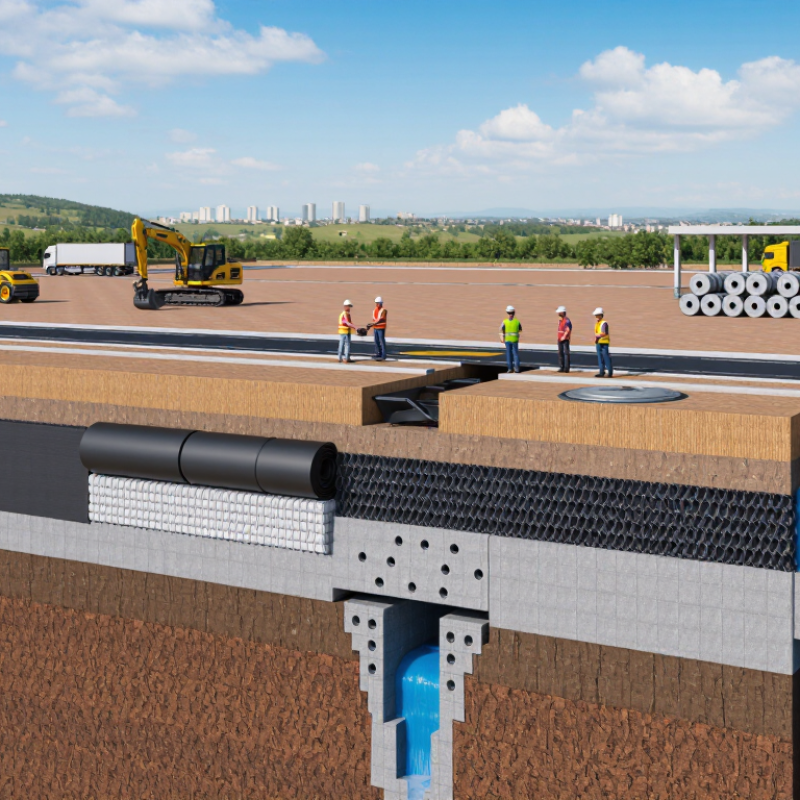
Geosynthetic materials are polymer-based products used with soil, rock, or water. Common types include geotextiles, geomembranes, geogrids, geocells, and geocomposites. They can separate weak soil, filter drainage water, reinforce slopes, control erosion, or prevent leakage.
A geotextile beneath a haul road, for example, keeps clay from mixing with crushed stone. A geomembrane can line a reservoir or waste containment area. These applications reduce material movement and may extend service life. They do not replace good engineering.
Grand View Research estimated the global geosynthetics market at around USD 13 billion in 2023, with continued growth expected through 2030. Its market analysis connects demand with roads, water infrastructure, mining, and waste management. MarketsandMarkets also identifies infrastructure development and environmental protection as major demand drivers. These figures are useful, but market estimates differ by product scope and region. Buyers should check the report methodology. That detail is easy to overlook.
For global procurement, performance matters more than a low purchase price.
Buyers should request tensile strength, puncture resistance, permeability, seam quality, UV stability, and chemical compatibility data. ASTM and ISO test methods improve comparison across suppliers. Local soil, rainfall, temperature, installation skill, and transport conditions also affect results. One material cannot solve every site problem.
A cheaper roll may become expensive after wrinkles, damage, or poor drainage appear. Independent testing and a project-specific design review remain sensible, even when schedules feel tight.
2026 Top Types of Geosynthetic Materials for Global Buyers
How Are Geosynthetic Materials Classified by Function and Structure?
Geosynthetic materials are classified by what they do and how they are built. Functional classes include separation, filtration, drainage, reinforcement, protection, and containment. A woven geotextile can separate crushed stone from weak soil beneath a road. A nonwoven geotextile filters water while retaining fine particles. Geogrids reinforce embankments and steep slopes. Geomembranes create low-permeability barriers for ponds, landfills, and industrial floors. Protection layers reduce puncture damage during installation.
Structural classification gives buyers another practical view. Geotextiles are woven, nonwoven, or knitted. Geogrids use ribs and apertures to transfer tensile loads. Geonets provide planar drainage. Geocomposites combine two or more functions, such as filtration and drainage. Geosynthetic clay liners contain bentonite between carrier fabrics. Geofoam offers lightweight filling where settlement or weak foundations create risk. Grand View Research’s 2024 market analysis projects roughly 6% annual growth for geosynthetics through 2030. MarketsandMarkets also identifies transportation, water management, and waste containment as major demand areas. These figures indicate expansion, not guaranteed project success.
Tips: Match the product to the soil, water chemistry, load, and installation method. Request tensile, puncture, permeability, and seam data. Do not choose by thickness alone. The classification can mislead when one product performs several roles. On real sites, poor overlap or careless backfilling can defeat excellent material. Field inspection still matters.
Geosynthetic materials help engineers control soil, water, drainage, and surface movement. The main types include geotextiles, geomembranes, geogrids, geonets, geocomposites, and geosynthetic clay liners. Each type solves a different problem. Geotextiles separate soil layers and support filtration around drainage pipes. Geomembranes create low-permeability barriers for ponds, landfills, and industrial containment areas. Geogrids strengthen weak soil beneath roads, railways, and working platforms.
Geonets provide drainage pathways, while geocomposites combine functions in one manufactured structure. Geosynthetic clay liners use bentonite layers to reduce liquid migration. Geofoam offers lightweight filling where deep soil replacement may cause settlement. In practice, material selection depends on tensile strength, puncture resistance, permeability, temperature, chemical exposure, and installation conditions. A thick product is not automatically better. That assumption can create unnecessary cost or handling problems.
Tips: Request test data, seam requirements, and installation guidance before buying. Check whether the material suits the local soil and climate. Ask for samples when surface texture or flexibility matters. Site experience shows that poor subgrade preparation can damage even high-quality products. Product certificates are useful, but they do not replace project-specific testing. Buyers should also review delivery packaging, roll dimensions, and storage limits. No geosynthetic performs perfectly in every environment. Reconsider the design when field conditions differ from the original survey.
Geotextiles, geomembranes, geogrids, geonets, geosynthetic clay liners, and geocomposites are the main geosynthetic material groups used in transportation, drainage, landfill, mining, hydraulic, and soil-reinforcement projects. The chart shows representative product-thickness midpoints based on commonly specified commercial ranges; actual dimensions vary according to polymer type, manufacturing method, mechanical requirements, and project standards.
Global buyers compare geosynthetic materials through measured performance, not product names. Geotextiles support filtration and separation. Geogrids improve soil reinforcement. Geomembranes provide hydraulic barriers, while geocomposites combine several functions. Grand View Research estimated the global geosynthetics market at about USD 13.8 billion in 2023, with continued growth through 2030. This expansion increases choice, but it also makes comparison less simple.
A tensile value alone can mislead. Buyers should review tensile strength under ASTM D4595 or ASTM D6637, puncture resistance under ASTM D4833, and water flow under ASTM D4491. ISO 10319 supports more consistent geosynthetic testing across international projects. For landfill liners, chemical resistance, seam quality, and long-term oxidation matter. For roads, aperture stability, installation damage, and confinement often matter more. A cheaper roll may fail during aggregate placement. That risk is easy to underestimate.
Tips: Request complete test reports, not only datasheet highlights. Match test conditions with local temperature, soil, and loading. Check whether values are typical or minimum. Review factory quality plans and independent laboratory results. Standards help, but they do not replace site experience. Even reliable data can miss poor installation. Examine overlaps, wrinkles, drainage paths, and field records before approval.
| Geosynthetic Type | Common Polymer / Structure | Primary Function | Key Performance Indicators | Indicative Performance Range* | Common Standards and Test Methods | Typical Applications | Buyer Selection Considerations |
|---|---|---|---|---|---|---|---|
| Woven Geotextile | Usually polypropylene or polyester; interlaced yarns | Separation, reinforcement, filtration and limited drainage | Tensile strength, puncture resistance, apparent opening size, permittivity, creep resistance | Mass commonly about 100–800 g/m²; tensile strength varies from below 20 to above 200 kN/m, depending on construction | ASTM D4595, ASTM D4632, ASTM D4751, ASTM D4491, ISO 10319, ISO 12956, EN ISO 10319 | Road and rail subgrades, working platforms, embankments, retaining structures, soft-soil improvement | Match the opening size to the soil gradation and check long-term strength under installation and sustained loading |
| Nonwoven Geotextile | Usually polypropylene or polyester; needle-punched or heat-bonded fibers | Filtration, drainage, separation, cushioning and erosion protection | Permittivity, transmissivity, apparent opening size, puncture resistance, mass per unit area | Mass commonly about 100–1,200 g/m²; permittivity and puncture resistance depend strongly on thickness and fiber structure | ASTM D4491, ASTM D4751, ASTM D4833, ASTM D4632, ISO 11058, ISO 12956, EN ISO 12956 | Underdrains, drainage layers, landfill protection, coastal works, filters around pipes and riprap | Evaluate clogging, soil compatibility, hydraulic performance under confinement and resistance to installation damage |
| Geomembrane | Flexible polymeric sheets, commonly HDPE, LLDPE, PVC, PP or EPDM | Low-permeability barrier and containment | Thickness, tensile and seam strength, puncture resistance, stress-crack resistance, permeability, chemical compatibility | Typical thickness about 0.75–3.0 mm; hydraulic conductivity is commonly targeted at approximately 1 × 10⁻¹¹ m/s or lower, subject to design and testing | ASTM D638, ASTM D7466, ASTM D4833, ASTM D5397, ASTM D5994, ASTM D6392, ISO 527, ISO 9863-1, GRI GM13/GM17 where specified | Landfill liners and caps, wastewater ponds, mining leach pads, reservoirs, canals, secondary containment | Select polymer by chemical exposure, temperature, UV conditions and expected service life; verify factory and field seam quality |
| Geogrid | Polyester, polypropylene or HDPE; uniaxial, biaxial or triaxial apertured grid | Soil reinforcement, aggregate confinement and load distribution | Tensile strength, junction strength, aperture geometry, stiffness, installation damage and creep reduction factors | Ultimate tensile strength commonly about 20–400 kN/m, depending on product direction and application | ASTM D6637, ASTM D7737, ASTM D4355, ISO 10319, ISO 13426-1, EN ISO 10319 | Mechanically stabilized earth walls, reinforced slopes, paved and unpaved roads, foundations and working platforms | Use design tensile strength after applying reduction factors for creep, installation damage, durability and environmental exposure |
| Geocell | Three-dimensional honeycomb confinement system, commonly HDPE or polymeric alloy | Lateral confinement, load spreading and surface stabilization | Cell depth, weld or joint strength, seam peel resistance, dimensional stability and confinement performance | Cell depths commonly about 50–300 mm; sheet thickness often approximately 1.0–1.5 mm, depending on the system | ASTM D6693, ASTM D4883, ASTM D4355 and project-specific seam, dimensional and installation tests | Unpaved roads, access roads, slope protection, channel lining, erosion control and load support over weak soils | Choose cell depth and infill according to slope angle, traffic load, aggregate size, drainage and anchorage requirements |
| Geosynthetic Clay Liner (GCL) | Bentonite clay layer encased between geotextiles, often needle-punched | Hydraulic barrier and supplemental lining component | Hydraulic conductivity, bentonite mass, swell index, peel strength, shear strength and chemical compatibility | Hydraulic conductivity commonly specified at 5 × 10⁻⁹ m/s or lower under defined test conditions; actual results depend on stress and permeant | ASTM D5887, ASTM D5890, ASTM D5993, ASTM D6496, ASTM D6243, ISO 10772 and project specifications | Landfill covers, waste containment, ponds, canals and low-permeability layers beneath or above geomembranes | Check bentonite compatibility with leachate, hydration conditions, confinement, slope stability and protection from premature wetting |
| Drainage Geocomposite | Geonet, geospacer or cuspated core combined with one or more geotextiles | In-plane drainage, filtration and sometimes protection | Transmissivity, compressive resistance, flow capacity under normal stress, filtration and clogging resistance | Transmissivity is product-specific and commonly reported in m²/s; performance may reduce significantly under high normal stress | ASTM D4716, ASTM D5199, ASTM D4751, ASTM D4491, ISO 12958, ISO 12956 and EN ISO 12958 | Landfill leachate collection, foundation drainage, retaining walls, tunnels, vertical drainage and liquid collection systems | Compare flow capacity at the project’s stress, gradient, temperature and design lifetime rather than using unconfined values |
| Erosion Control Geosynthetic | Biodegradable natural fibers or durable polymeric mats, blankets and three-dimensional structures | Temporary or permanent soil-surface protection and vegetation establishment | Open area ratio, shear stress or permissible velocity, tensile strength, UV resistance and service duration | Service life ranges from seasonal temporary protection to multi-year or permanent systems; hydraulic limits are product- and site-specific | ASTM D6525, ASTM D6566, ASTM D6460, ASTM D6818, EN 13252 where applicable, plus project-specific hydraulic testing | Riverbanks, channels, embankments, road cuts, construction sites, wetlands and revegetated slopes | Define whether the system is temporary or permanent and compare performance with expected rainfall, runoff, flow velocity and vegetation growth |
| Geopipe | Perforated or solid thermoplastic pipe, commonly HDPE, PVC or polypropylene | Liquid or gas conveyance and subsurface drainage | Ring stiffness, crush resistance, hydraulic capacity, joint performance, chemical resistance and perforation area | Nominal diameters commonly range from about 50 mm to more than 1,000 mm; stiffness class and wall design vary by standard and application | ASTM F405, ASTM F667, ASTM F810, ASTM F2788, ISO 9969, EN 13476 and applicable national pipe standards | Subsoil drains, landfill drainage, agricultural drainage, stormwater systems, leachate collection and road drainage | Confirm pipe stiffness, burial depth, bedding, backfill gradation, flow demand, access for maintenance and connection details |
For global buyers, the right geosynthetic material starts with site conditions, not product popularity. Short answer: project conditions decide. The Grand View Research 2024 market report estimates the global geosynthetics market reached about USD 8.8 billion in 2023, reflecting wider use in roads, mining, drainage, and waste containment. Growth does not remove design risk.
Soil strength and expected loading guide the choice between geotextiles, geogrids, and geocells. A soft road subgrade may need separation and filtration, while a heavily trafficked embankment requires tensile reinforcement. For ponds, landfills, or industrial containment, geomembranes and geosynthetic clay liners must match chemical exposure, puncture risk, and leakage-control targets. The 2023 Global Waste Management Outlook reports that municipal solid waste could reach 3.8 billion tonnes annually by 2050, increasing demand for reliable containment systems.
Water movement matters just as much. Designers should check permeability, drainage capacity, hydraulic gradients, and clogging potential. Temperature, ultraviolet exposure, freeze-thaw cycles, and installation damage also affect long-term performance. Independent testing against relevant ASTM or ISO methods improves buyer confidence, but laboratory results cannot replace field inspection. That is an uncomfortable limitation.
Project teams should request seam-strength data, abrasion resistance, chemical compatibility, and documented quality-control records. Life-cycle cost deserves attention too; a cheaper roll may create expensive repairs. However, carbon impact is often assessed poorly. Transport distance, recycled content, service life, and end-of-use options should be measured together, not promoted as isolated claims.