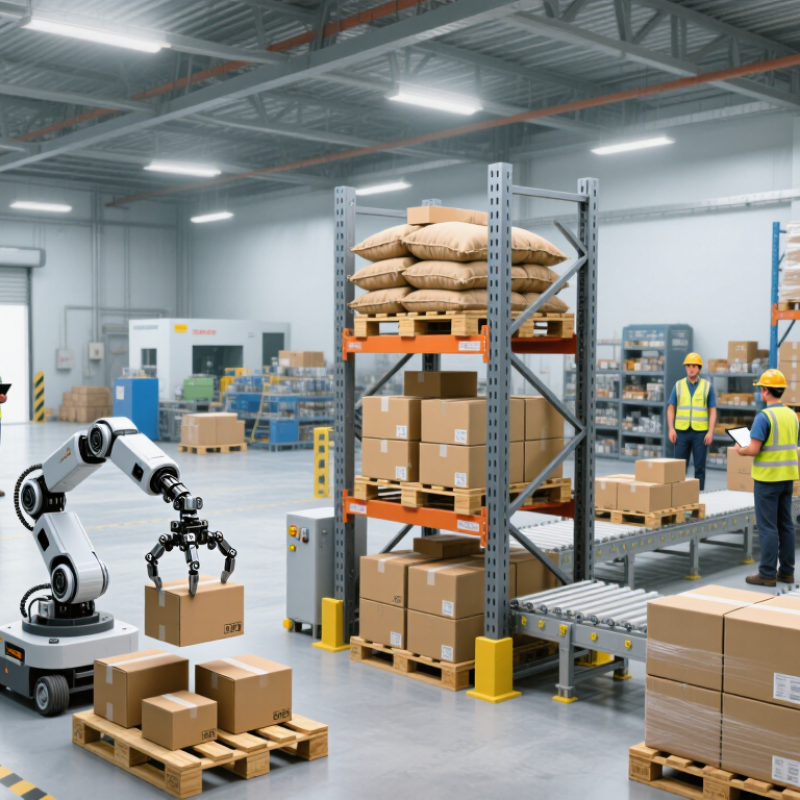
2026 Best Palletizing Machine for Global Buyers?

Choosing the 2026 Best Palletizing Machine for global buyers requires more than comparing speed and price. A modern Palletizing Machine must handle changing carton sizes, uneven loads, and demanding production schedules. It should also fit the factory’s available floor space. Every detail matters.

Jeff Burnstein, a recognized robotics-industry authority, once described automation’s purpose clearly: “Robots are not going to take your job; they’re going to take the boring, dirty, dangerous jobs.” This principle remains useful when evaluating palletizing equipment. A dependable system should reduce repetitive lifting while supporting safer, more consistent work.

Global buyers should examine payload capacity, reach, cycle rate, gripper design, control software, and energy use. Service access matters too. A machine may perform perfectly in a showroom but struggle beside a dusty conveyor or narrow loading area. That happens.

Reliable suppliers provide installation guidance, operator training, spare-parts planning, and responsive technical support. Buyers should request production trials using real cartons, real pallets, and realistic speeds. Laboratory demonstrations can hide weaknesses.

No single machine wins every factory. A compact robotic model may suit a beverage line, while a high-speed layer palletizer may better serve heavy bags or cases. Budget forecasts should include maintenance, downtime, integration, and future product changes. The cheapest quote can become expensive later.

This guide compares leading 2026 solutions through practical performance, safety, flexibility, and long-term value. Some conclusions remain imperfect because factory conditions differ. That is why careful testing should guide the final decision.

2026 Best Palletizing Machine for Global Buyers?

What Is a Palletizing Machine and How Does It Work?

A palletizing machine automatically stacks cartons, bags, trays, or cases onto a pallet. It replaces repeated manual lifting with a controlled handling process. In a typical line, products travel along a conveyor and pass through sensors. A programmable controller tracks their position, orientation, and quantity.

The machine then groups products into a selected pattern. A robotic arm, layer-forming unit, or mechanical gripper places each group on the pallet. Each layer can rotate to improve stability. Slip sheets may separate layers when cartons need extra support. The completed load moves to wrapping or storage equipment. Small details matter, such as carton stiffness, product temperature, and pallet quality.

From practical line evaluations, the best 2026 choice is not always the fastest model. A high-speed unit may struggle with uneven packages or frequent product changes. I have seen a good stacking pattern fail because the conveyor timing was slightly wrong. That mistake is easy to overlook. Buyers should check changeover time, sensor accuracy, guarding, cleaning access, and maintenance training. Factory trials with real products can reveal problems that brochures hide. A reliable machine should also provide clear fault messages and stable operation across different load heights. Even then, operators may need to adjust speed, gripping force, and layer spacing during seasonal production changes.

Key Palletizing Machine Types for Different Global Industries

2026 Best Palletizing Machine for Global Buyers?

Key Palletizing Machine Types for Different Global Industries

Palletizing machines should match product shape, package strength, and daily production speed. Robotic palletizers suit mixed cartons, flexible layouts, and frequent product changes. They can place cases in careful patterns, even when floor space is limited. Layer palletizers work better for high-volume food, beverage, and household goods lines. They build complete layers quickly, but they need consistent carton dimensions. That detail is often underestimated.

Bag palletizers handle rice, flour, animal feed, and powdered materials. Their gripping tools must control shifting contents without damaging bags. Case palletizers are common in consumer goods and e-commerce facilities. They support stable carton stacking and simpler conveyor integration. For heavy bags, cement, or mineral products, mechanical systems may provide stronger handling and predictable cycle times. They are less flexible, though.

Pharmaceutical and personal care operations need gentle motion, cleanable surfaces, and traceable settings. A robotic system may offer better product changeovers, but its software requires disciplined maintenance. Food plants should examine washdown design, moisture protection, and hygienic access points. Global buyers also need to check power standards, operator training, spare parts, and local service response. The fastest machine is not always the best fit. A trial with real cartons, damaged packages, and full pallet patterns can reveal uncomfortable problems before installation.

2026 Best Palletizing Machine for Global Buyers

Key Palletizing Machine Types for Different Global Industries

The chart compares typical operating throughput ranges for major palletizing machine categories. Conventional layer palletizers generally support the highest throughput for standardized cases, while robotic and collaborative systems provide greater flexibility for mixed products, variable pallet patterns, and smaller production lines.

Throughput is shown in cases per minute and varies with product weight, packaging format, pallet pattern, gripper design, and line configuration.

How to Select the Best Palletizing Machine for 2026

Selecting the best palletizing machine for 2026 starts with the product, not the catalog. Measure case weight, dimensions, compression strength, and line speed across a full production shift. A machine rated for 1,200 cases per hour may struggle when cartons deform or arrive unevenly. Real conditions matter. The International Federation of Robotics recorded 541,302 industrial robot installations worldwide in 2023. This figure confirms automation remains a major manufacturing investment area.

Compare robotic, conventional layer, and hybrid systems against your actual SKU mix. Robotic cells suit frequent changeovers and mixed patterns. Layer machines often favor stable, high-volume cartons. Request a witnessed factory acceptance test using your pallets, film, labels, and weakest cases. Check pattern accuracy, jam recovery, guarding, cleaning access, and operator training time. Energy use deserves measurement. The U.S. Department of Energy’s Industrial Decarbonization Roadmap identifies efficiency as an important industrial competitiveness factor.

For global purchasing, audit electrical standards, language support, spare-parts availability, and remote diagnostics before signing. Ask for lifecycle costs, not only purchase price. Include gripper wear, software updates, sensors, pallets, and planned downtime. ISO 12100 risk assessment and ISO 13849 safety principles should guide technical discussions. Local compliance still requires qualified professional verification. Do not trust a beautiful demonstration. Small carton variation can expose large design weaknesses. That uncomfortable test may be the most valuable selection tool.

Essential Features, Performance Metrics, and Safety Standards

2026 Best Palletizing Machine for Global Buyers?

Essential Features, Performance Metrics, and Safety Standards

A capable palletizing machine must match your real production conditions, not only a brochure’s headline speed. Check payload, pallet size, product dimensions, stacking patterns, and required reach. Cycle rate matters, but stable cycle rate matters more. A machine claiming 1,200 cases per hour may slow sharply with mixed formats or frequent changes. Measure output during a complete shift.

Repeatability should be recorded in millimeters. Also track changeover time, compressed-air use, energy consumption, fault frequency, and recovery time. In factory trials, observe cartons after several hours. Leaning layers often reveal problems hidden during short demonstrations. We have found that simple pattern software can outperform complex features when operators need quick adjustments. This is not always obvious.

Safety requires more than an emergency-stop button. The system should include guarded areas, interlocked access doors, clear warning signals, and safe maintenance access. A documented risk assessment should guide the design, with suitable control-system performance levels. Buyers should request evidence of testing against relevant machinery safety standards, such as ISO 12100 and ISO 13849, while confirming local requirements. Training records, inspection schedules, and spare-part support also affect reliability. Do not ignore the operator’s view. A technically strong machine can still fail in practice if controls are confusing or cleaning is difficult.

2026 Best Palletizing Machine for Global Buyers? - Essential Features, Performance Metrics, and Safety Standards

Category Evaluation Dimension Typical Requirement or Performance Range Why It Matters to Global Buyers
Essential Machine Features Payload per pick Approximately 5–50 kg per case or bag, depending on the robot, gripper, and product center of gravity. The rated payload must include the product, tooling, clamps, vacuum components, and any dynamic load effects.
Pallet compatibility Common pallet footprints include 1,200 × 800 mm and 1,200 × 1,000 mm; other sizes should be configurable through the pallet pattern software. Using internationally common pallet dimensions simplifies logistics and reduces the need for custom handling equipment.
Palletizing height Typically 1,600–2,200 mm from the pallet surface, subject to product stability, pallet height, and local handling limits. A higher stack can improve transport efficiency, but excessive height may reduce load stability and increase workplace risks.
Gripper flexibility Recommended options include fork, clamp, vacuum, layer, or hybrid grippers with adjustable contact points. The gripper should maintain reliable control of cartons, sacks, trays, and shrink-wrapped products without crushing or slipping.
Recipe management At least 50–200 stored product and pallet-pattern recipes, with access control and backup functionality. Fast recipe changeover supports multiple stock-keeping units and reduces programming time during production changes.
Integration interfaces Ethernet-based industrial communication, discrete I/O, barcode or vision interfaces, and connection to conveyors and warehouse systems. Open communication options make it easier to integrate the machine into different international production and warehouse environments.
Environmental suitability Typical indoor operating range: 5–40°C, relative humidity up to 85% non-condensing, with protection level selected for dust and washdown exposure. The actual environment determines enclosure ratings, corrosion protection, lubrication intervals, and component life.
Maintenance access Tool-free or low-tool access to wear parts, centralized lubrication points, diagnostic messages, and documented preventive-maintenance intervals. Accessible maintenance areas reduce downtime and help local technicians service the machine without depending on overseas visits.
Performance Metrics Throughput Approximately 10–30 cases per minute for many robotic applications; higher rates may be achievable with layer palletizing and standardized products. Throughput should be tested using the buyer’s actual product dimensions, weight, pallet pattern, and conveyor spacing.
Positioning repeatability Approximately ±0.5–2 mm at the tool under controlled conditions; actual stack alignment depends on product consistency and pallet quality. Repeatable placement improves pallet stability, reduces damaged packaging, and supports predictable warehouse handling.
Changeover time Approximately 5–20 minutes for software recipe changes; mechanical gripper or guide adjustments may require additional time. Short changeovers are valuable where production includes multiple package sizes or frequent export orders.
Availability target A practical design target is 95–98% technical availability, excluding planned maintenance, material shortages, and upstream line stoppages. Availability figures should be defined clearly because overall line efficiency is affected by equipment outside the palletizer.
Electrical demand Common machine loads are approximately 3–15 kW, excluding upstream conveyors, pallet dispensers, stretch wrappers, and other auxiliary equipment. Buyers should confirm voltage, frequency, short-circuit rating, grounding, and local electrical-code requirements before ordering.
Compressed-air requirement Often 5–7 bar supply pressure; consumption varies widely with vacuum generators, pneumatic clamps, and operating cycles. Air quality, pressure stability, filtration, and actual consumption affect grip reliability and operating cost.
Noise level Many installations target below 75 dB(A) at the operator position, but conveyors, pneumatics, and packaging equipment may increase total workplace noise. Noise must be measured after installation and controlled according to the applicable occupational-health regulations.
Footprint and layout Approximately 3–8 m² for the core cell, excluding safety clearance, conveyors, pallet storage, maintenance access, and downstream wrapping equipment. A complete layout review prevents conflicts with forklift routes, emergency exits, building columns, and maintenance areas.
Safety Standards and Verification Robot safety design ISO 10218-1 and ISO 10218-2, using the applicable edition and local adoption requirements for industrial robots and robot systems. The integrator should document risk reduction, safeguarding, operating modes, emergency stops, and validation of the complete robot cell.
Risk assessment ISO 12100 principles for hazard identification, risk estimation, risk reduction, and verification. A machine should be assessed as a complete system, including conveyors, pallets, tooling, utilities, access points, and foreseeable misuse.
Safety-related control systems ISO 13849-1 or IEC 62061, with the required performance level or safety integrity level determined by the risk assessment. Safety circuits should be validated rather than accepted solely on the basis of component certificates.
Electrical equipment IEC 60204-1 or the applicable national equivalent for electrical equipment of machinery. Verification should cover protective bonding, disconnecting means, short-circuit protection, wiring, control panels, and emergency-stop circuits.
Safeguarding and access control Fixed guards, interlocked gates, presence-sensing devices, safe distances, and clearly visible reset controls selected according to the risk assessment. Safety devices must prevent unexpected restart and provide adequate protection from crushing, trapping, impact, and falling loads.
Emergency stop and restart behavior Emergency-stop devices should be accessible, clearly identified, manually reset, and designed so that reset does not automatically restart motion. Correct stop categories and restart logic reduce the risk of injury during intervention, clearing faults, and maintenance.
Compliance documentation Require a risk assessment, electrical drawings, pneumatic diagrams, operating instructions, maintenance schedule, safety validation record, and applicable declaration of conformity. Complete documentation supports customs clearance, local inspections, operator training, maintenance, and future line modifications.
Buyer Acceptance Checklist Product and pallet trial Test every critical product format, packaging material, pallet type, layer pattern, and target stack height under production-speed conditions. Factory acceptance testing should use representative samples rather than idealized demonstration products.
Measurement definitions Define throughput, availability, accuracy, reject rate, changeover time, and energy consumption using agreed measurement methods. Clear definitions prevent disputes caused by different interpretations of speed, uptime, and usable production output.
Operator and maintenance training Provide training for normal operation, recipe changes, fault recovery, lockout/tagout, inspection, lubrication, and safe manual intervention. Training quality directly affects safety, availability, and the machine’s long-term operating cost.
Spare-parts strategy Identify critical spare parts, recommended stock levels, lead times, interchangeable components, and local technical-support arrangements. A documented spare-parts plan limits downtime when international shipping or customs clearance is required.
Final site validation Complete site acceptance testing after installation, including safety functions, production rate, pallet quality, noise, utilities, and operator procedures. Final validation confirms that the integrated cell—not only the individual machine—meets the agreed technical and safety requirements.

Note: The figures shown are representative selection ranges for industrial palletizing applications. Final values depend on product geometry, packaging strength, pallet pattern, tooling, line layout, local regulations, and the completed risk assessment.

Installation, Maintenance, Costs, and Global Purchasing Factors

2026 Best Palletizing Machine for Global Buyers?

Installation, maintenance, and purchasing choices shape real palletizing performance. A machine should match carton size, pallet height, product weight, and required cycles per minute. During commissioning, technicians should test the complete pallet pattern, not only an empty gripper. Uneven floors can create vibration, so buyers should confirm anchoring requirements before shipment. Electrical voltage, compressed-air quality, and local safety standards also need early review.

The International Federation of Robotics reported 541,302 industrial robots installed worldwide in 2023. This shows strong automation demand, but robotics alone does not guarantee reliable pallet handling.

Maintenance planning must include vacuum cups, pneumatic valves, sensors, lubrication points, and gearbox inspections. Keep critical spare parts near the production site. A two-week shipping delay can stop a packaging line.

Purchase cost is only one part of ownership. Buyers should calculate integration, guarding, conveyors, freight, customs, training, software support, and energy use. MHI’s 2024 Annual Industry Report found that 55% of supply-chain professionals planned to increase technology investment. Still, cheaper equipment can become expensive when local service is weak. This is an uncomfortable purchasing lesson.

Tips: Request a factory acceptance test using your actual cartons and pallet pattern. Ask for maintenance intervals in operating hours, not vague calendar promises. Compare three-year ownership costs in the buyer’s currency. Leave space for future product changes. A perfect forecast is impossible. That is why modular tooling and adjustable software matter.

Article Source:

SERVO-ROBOT Inc
Privacy Overview

This website uses cookies so that we can provide you with the best user experience possible. Cookie information is stored in your browser and performs functions such as recognising you when you return to our website and helping our team to understand which sections of the website you find most interesting and useful.